Notes from a Trauma Olympian
How I Stay Human When Everything Sucks
Things are really, really, really stressful right now. For everyone.
And when stress stops being a storm and starts becoming the weather, it changes us. It reshapes how we breathe, how we speak, how we reach for one another. It changes how we grow and how we love.
Beyond what we’re each carrying individually, I think we’ve all watched someone we love start to give way under the weight of this creeping, amorphous despair. You can see it in the murk that dims the glimmer behind their eyes, in the snap of newly shortened tempers, in the kind of tiredness that sleep can't touch. This stress, this exhaustion, this desperate clinging to routine and attempts at maintaining hope is instantly recognizable to people like me. It's familiar terrain for those of us who live with complex PTSD.
Complex PTSD has shaped most of my adult life. While I’ve never kept it hidden, it’s not something I usually offer up at dinner parties, for reasons that are probably obvious. While cPTSD is far from the most interesting thing about me, it’s not incidental either. It’s framed how I move through the world: more quietly than I used to, more consistently than I expected, and with a kind of tenderness I didn’t know I was capable of.
One of the most grueling parts about living with cPTSD, for me, isn’t the intensity, it’s the persistence. The way your nervous system never quite powers down. Your conscious brain knows you’re not in crisis, but your cerebellum braces anyway. Eventually, you learn to function despite the signals being sent to your body. You learn to cope when your adrenal glands flood your bloodstream with adrenaline. You learn how to stay present while every cell in your body is screaming at you to fight, run, freeze, or fawn. You find ways to steady yourself that don’t require pretending everything is okay.
After living in that dissonance long enough, you start to build something. A rhythm. A toolkit. A quiet kind of wisdom. It’s not pretty, it’s far from flawless, but it’s yours and knowing it’s there when you need to reach for it provides one of the very few safety nets you have left.
What follows here isn’t official advice. It’s just a handful of practices I return to when the world feels impossible. They’re small, sensory, and mostly practical. While they won’t fix what’s wrong, they do a lot of the heavy lifting of helping me stay present, helping me remember that tomorrow will come, and that I will still be here when the dawn finally breaks.
Try Cold Therapy
I stash disposable ice packs everywhere: purse, glove compartment, desk drawer. When I feel that strange, panicky ‘I-don’t-know-why-I’m-not-okay’ feeling, I’ll crack one open and hold it to my forehead.
Here’s why: the vagus nerve runs along your face and neck and helps regulate your parasympathetic nervous system (the one responsible for calming you down). When cold is placed near your eyes or forehead, your body thinks it’s being submerged into cold water and automatically flips on the ‘mammalian dive reflex’. Your heart rate slows. Your breathing evens out. This is your body’s built-in emergency brake for hypothermia, and conveniently, also great for nervous systems on the brink of meltdown.
If holding an icepack to your face in public feels a bit too conspicuous, try holding a couple of ice cubes in your hands. Let yourself really feel them. Notice how the cold bites a little, how the water drips down your wrists, how your skin reacts. What you’re trying to do is pull your brain back from the abstract: doom, fear, helplessness, and push it into the immediate. You’re saying: This is where we are. Right here. Right now. And we are okay.
Take Your Shoes Off
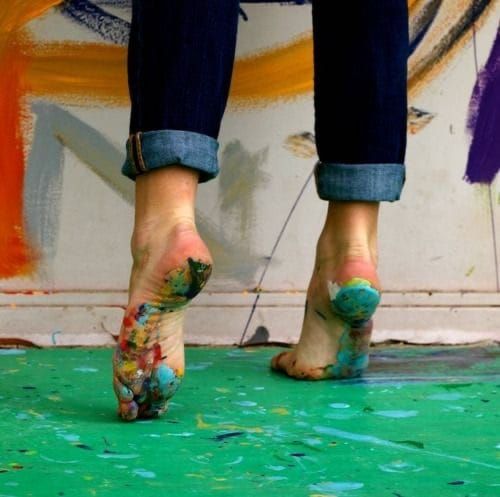
Grass, tile, dirt, carpet, it doesn’t matter. Just put your bare feet on the ground. Let your body know where it is. Give your sensory system a break from the digital firehose. You’re reminding your nervous system that it has a body, and that body belongs somewhere in space and time.
If you can’t get outside, open a window. Change rooms. Turn your face toward the light.
Ground Through Beauty
The traditional grounding technique of “five things you can see, four you can feel” works. But sometimes it makes me feel like I’m failing a pop quiz. So instead, I pull out my tiny watercolor kit. A few pans of color, a collapsible brush and anything nearby that can hold water.
I load my brush with color and start moving it around the page. I let it bleed. I let it pool. I don’t try to make anything. I just try to notice how the color shifts as it dries. How water chooses its own path. How I can’t rush it, no matter how hard I try. It’s not art. It’s presence.
Make Life Stupidly Simple
Pancakes for dinner. Same shirt as yesterday. Paper plates. Frozen broccoli again. No childhood has ever been ruined by eating waffles three nights in a row.
Lower the bar. Then lower it again. Then crawl under it with a blanket and say: This is what I have. It’s enough.
Do Something Dumb and Delightful
Bake the worlds ugliest cake. Crochet a gallbladder. Show your teenager how we used to apply eyeliner in the 90’s. The point isn’t productivity. The point is spark. Ten minutes of joy is an act of resistance.
Build Something You Can Destroy
Jenga towers. Lego castles. Shoebox cities. Construct them just so you can knock them down. Play Godzilla with your kids. Use a sock with a tennis ball in it as a wrecking ball. Shout “timber” as it all topples. Laugh as it falls. You’re allowed to feel chaos. Giving it a shape you can dismantle can help.
Tell the Truth
Say it out loud. To your partner. To a friend. To a journal. To a voice memo. To your therapist. To yourself.
Say: I’m not okay. Say: I need help. Say: This is too much. Say: I feel like I’m failing.
You’re not failing. You’re not broken. But pretending you’re fine while your nervous system is in revolt? That’s a shortcut to collapse.
This Is Not Your Fault
We were not designed for this. No human was built to function under this level of continuous stress. You’re not malfunctioning, you’re adapting. You’re not failing, I promise. You’re doing the best you can with what you have. And if all you managed today was to drink a glass of water, answer one email, or keep yourself from spiraling for ten minutes? That’s not nothing. That’s survival. That’s resilience. That’s love.
But most of all; it matters. And you matter too.