Grilled Cheese, Moral Clarity, and Other Things I’m Learning to Wait For
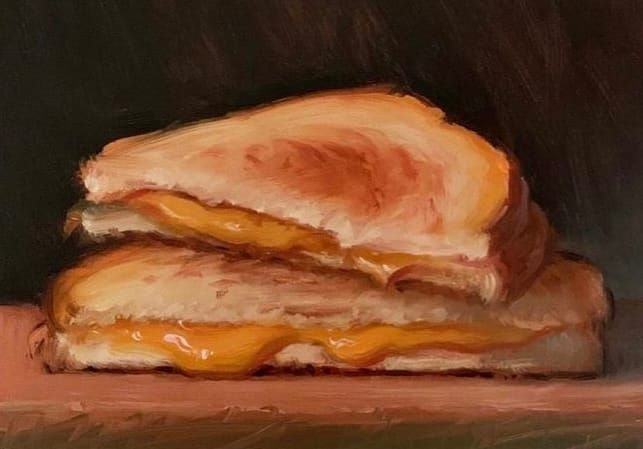
I make the world’s worst grilled cheese sandwiches.
They are truly terrible. Somehow they end up both underdone and scorched. It’s strange, considering I went to culinary school and once wrote an entire term paper about sandwiches: their pitfalls, their perfection, and everything in between. I know the theory. I understand how to manipulate the variables down to the molecular level.
But when I’m hungry, I’m impatient. I flip too early. I crank the heat and hope for the best, which, unsurprisingly, has never actually worked.
The cheese stays unmelted. My once-perfect bread turns to carbon in the skillet. Eventually, in a famished huff, I toss the whole mess into the dog’s dish and make something else.
Lately, I’ve been thinking about that reflex, the temptation to call something ruined because it’s taking too long. The urge to give up before it’s ready. The impatience that shows up when our stomachs rumble and we feel like we can’t hold out for one more second, and still, nothing. No movement. No end in sight. It’s so easy to declare it over, to say it failed, to call it burned beyond saving and move on, leave the charred mess for someone else. But not everything that takes too long is ruined. Some things need more time. Some people do too.
The thing about grilled cheese, or anything that requires slow heat, is that it isn’t really a test of technique. It’s a test of belief. You can’t rush molecules to unlearn their structure. You can’t force the center to soften by sheer will. You have to trust that steady warmth will reach what’s cold before it burns what’s tender. That’s the discipline. That’s the practice. And honestly, that’s the work of repair.
Because the patience that keeps a sandwich from scorching is the same patience that keeps people from giving up on one another. It’s what turns shock into insight, injury into instruction, pain into something that can be used for good. Slow heat changes texture long before it changes form, and moral transformation works the same way: invisible at first, then irreversible.
Trauma researchers call this altruistic repair, the impulse to transform private suffering into protection for others (Tedeschi & Calhoun, 2004). It often shows up as an ache to prevent future harm, particularly when systems have failed to act. Theologian Serene Jones describes it as public testimony, not spectacle or vengeance, but the moral act of turning personal pain into a shared, redemptive record (Jones, 2009).
Patience, in this light, becomes something more than waiting. It becomes resistance. It becomes care. It becomes, in its own way, love.
So I’ve been practicing patience. Not the passive, tidy, self-erasing kind. But the kind that stays in the kitchen. That lowers the heat. That breathes through the hunger. The kind that waits, not because it’s easy, but because something good is still possible.
Because this time, there’s no dog’s dish to toss this mess into.
Only a future worth getting right. Together.